Arrhenius scaling in the P Model
Run this notebook
Read the guide on setting up your computer to run Jupyter notebooks
Download
this notebookas a Jupyter notebook.
Warning
This document discusses the form of the Arrhenius scaling used for estimating
temperature scaling of \(V_{cmax}\) and \(J_{max}\) in the P Model. Although pyrealm
provides flexibility for different forms, this is an active research area.
We currently strongly recommend the use of the simple method for Arrhenius scaling
when fitting a P Model. The kattge_knorr method scaling is implemented for
experimental purposes only.
The rates of enzyme kinetics in the PModel and SubdailyPModel vary with the
temperature of the enzyme reactions following an Arrhenius relationship scaling.
In most cases, the rates are described using a “simple” Arrhenius relationship. Given the activation energy for the system (\(H_a\)), the universal gas constant \(R\) and a constant \(c\), the rate at temperature \(T\) is:
In general, rate calculations in the P Model use rate factors (\(f\)), relative to a fixed reference temperature \(T_0\):
This simple scaling factor is appropriate for calculating temperature scaling of two key enzyme systems:
The photorespiratory CO2 compensation point (
gammastar, \(\Gamma^\ast\),calculate_gammastar()).The Michaelis Menten coefficient of Rubisco-limited assimilation (
kmm, \(K_{MM}\),calculate_kmm()).
Scaling of \(V_{cmax}\) and \(J_{max}\)
The simple scaling factor above is also used in the original description of the P Model (Prentice et al., 2014, Wang et al., 2017) for calculating Arrhenius scaling of \(V_{cmax}\) and \(J_{max}\). This scaling is not required to calculate GPP in the standard P Model, but is used to calculate representative values of those rates at standard temperatures (\(V_{cmax25}\) and \(J_{max25}\)).
Arrhenius scaling is however central to the Subdaily P Model (Mengoli et al., 2022). Here, the scaling is used to convert between realised daily estimates of acclimating \(V_{cmax}\) and \(J_{max}\) and the values of \(V_{cmax}\) and \(J_{max}\) for subdaily observations:
Daily realised rates at daily representative temperatures are converted to daily realised rates at standard temperatures (daily realised \(V_{cmax25}\) and \(J_{max25}\)).
The daily realised values at standard temperatures are then mapped back on to the subdaily scale and converted back to the appropriate values at the observed subdaily temperature (\(V_{cmax}\) and \(J_{max}\) at subdaily scales).
However, there is some discussion about the form of the scaling of reaction rates of
\(V_{cmax}\) and \(J_{max}\) with temperature, particularly the suggestion that these rates
should be “peaked”, declining at higher temperatures. Kattge and Knorr (2007) presented
a form of this peaked relationship, using the growing temperature (\(T_g\)) of the plant
to define the location of a peak. This form is used in the rpmodel implementation of
the P Model, although rpmodel currently sets the growth temperature to be equal to the
observed temperature (leaf or air temperature).
The plot below shows some examples of Arrhenius factor curves using these different
approaches. Two separate growth temperatures are used with the kattge_knorr method. At
present, the implementation of the standard P Model in the rpmodel package uses the
form of the kattge_knorr method but sets \(t_g=T\), rather than having a fixed growth
temperature. This leads to the curve labelled rpmodel in the plot, which does not have
a peak.
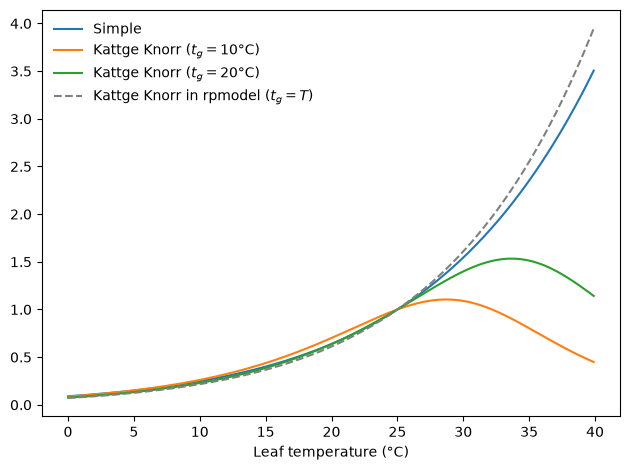
Note that we do not the additional factor \(T/T_0\) in the calculation of the peaked form. This was initially suggested by Murphy and Stinziano (2021), but was later agreed to be unnecessary (Stinziano and Murphy, 2021, Yin, 2021)
Using different Arrhenius scaling
The method_arrhenius argument to PModel and SubdailyPModel allows the form of the
scaling of \(V_{cmax}\) and \(J_{max}\) to be switched between different models. At present,
pyrealm implements two alternative options:
simple: This uses the equation shown above, implemented in the functioncalculate_simple_arrhenius_factor().kattge_knorr: This uses a peaked form of the relationship, implemented in the functioncalculate_kattge_knorr_arrhenius_factor(). To use this method in a P Model, users need to provide values for the growth temperature \(t_g\), which modulates the location of the peak in the relationship, when creating a PModelEnvironment instance. To duplicate the current behaviour ofrpmodel, where \(T=t_g\), themean_growth_temperaturecan just be set to be the same as the air temperature.As noted at the top of the page, we do not recommend this option for normal use in the P Model.