C3 / C4 Competition
Run this notebook
Read the guide on setting up your computer to run Jupyter notebooks
Download
this notebookas a Jupyter notebook.
Compared to C3 plants, plants using the C4 photosynthetic pathway:
cope well in arid areas, operating with lower stomatal conductance and lower leaf internal CO2 than C3 plants,
are strongly favoured in lower atmospheric CO2 concentrations, and
do not experience significant photorespiration costs.
This gives C4 plants a substantial competitive advantage in warm, dry and low CO2
environments. The C3C4Competition class provides an
implementation of a model (Lavergne et al., 2022) that estimates the expected fraction
of GPP from C4 plants. It uses predictions of GPP from the
PModel assuming communities consisting solely of
C3 or C4 plants to calculate the expected fraction of C4 plants in the community and the
contributions to GPP from C3 and C4 plants at each site.
Step 1: Proportional GPP advantage
The first step is to calculate the proportional advantage in gross primary productivity (GPP) of C4 over C3 plants (\(A_4\)) in the study locations.
Step 2: Convert GPP advantage to the fraction of C4 plants
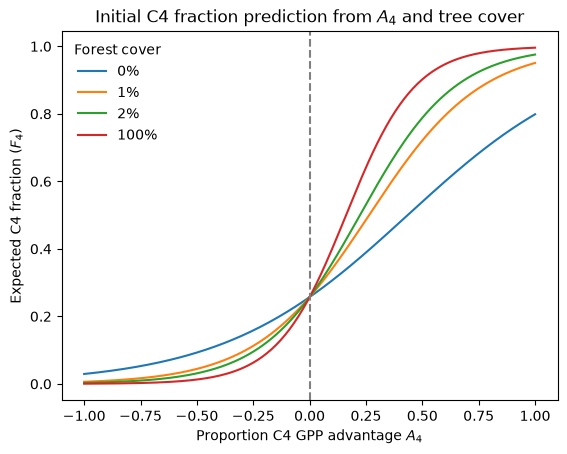
A statistical model is then used to convert the proportional C4 GPP advantage to the
expected C4 fraction (\(F_4\)) in a community (see
C3C4Competition for details). This model includes a
correction term for the estimated percentage tree cover and the plot below shows how
\(F_4\) changes with \(A_4\), given differing estimates of tree cover.
Step 3: Account for shading by C3 trees
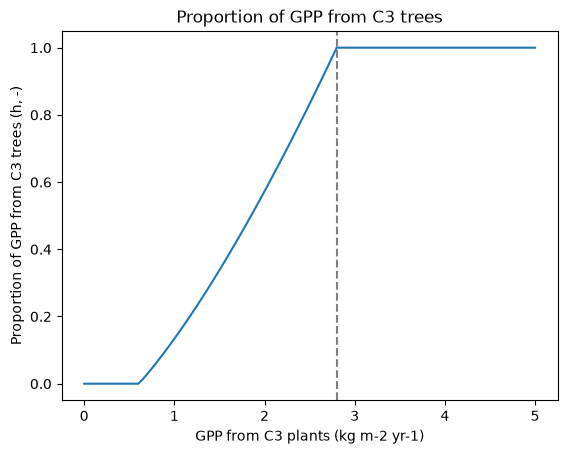
The fraction of C4 plants can be reduced below expectations simply from relative GPP advantage by shading from C3 trees. A statistical model is used to predict the proportion of GPP expected from C3 trees (\(h\)) and this is used to discount \(F_4 = F_4 (1-h)\).
The plot below shows how \(h\) varies with the expected GPP from C3 plants alone. The dashed line shows the C3 GPP estimate above which canopy closure leads to complete shading of C4 plants.
Step 4: Filtering cold areas and cropland
The last steps are to set \(F_4 = 0\) for locations where the mean temperature of the
coldest month is below a threshold for the persistence of C4 plants (below_t_min) and
then to remove predictions for croplands (cropland), where the C4 fraction is driven
by agricultural management.
Predicted GPP and expected isotopic signatures
The resulting model predicts the fraction of GPP from C4 and hence the actual contributions to total GPP from the C3 and C4 pathways. In addition, the model can be used to generate the expected isotopic signatures resulting from the predicted fractions of C3 and C4 plants.
Worked example
The code below shows the various stages of the model for example annual GPP predictions for C3 plants and C4 plants alone across a temperature gradient with an estimated tree cover of 0.5.
Code
# Use a simple temperature sequence to generate a range of optimal chi values
n_pts = 51
tc_1d = np.linspace(-10, 45, n_pts)

# Fit C3 and C4 P models
env = PModelEnvironment(tc=tc_1d, patm=101325, co2=400, vpd=1000, ppfd=450, fapar=0.9)

mod_c3 = PModel(env, method_optchi="prentice14")

mod_c4 = PModel(env, method_optchi="c4")

# Competition, using annual GPP from µgC m2 s to g m2 yr
gpp_c3_annual = mod_c3.gpp * (60 * 60 * 24 * 365) * 1e-6
gpp_c4_annual = mod_c4.gpp * (60 * 60 * 24 * 365) * 1e-6

# Fit the competition model
comp = C3C4Competition(
    gpp_c3=gpp_c3_annual,
    gpp_c4=gpp_c4_annual,
    treecover=0.5,
    below_t_min=False,
    cropland=False,
)

# Calculate step by step components of model
frac_c4_step2 = convert_gpp_advantage_to_c4_fraction(comp.gpp_adv_c4, 0.5)
prop_trees = calculate_tree_proportion(gppc3=gpp_c3_annual / 1000)
frac_c4_step3 = frac_c4_step2 * (1 - prop_trees)

# Generate isotopic predictions
isotope_c3 = CarbonIsotopes(mod_c3, d13CO2=-8.4, D14CO2=19.2)
isotope_c4 = CarbonIsotopes(mod_c4, d13CO2=-8.4, D14CO2=19.2)

comp.estimate_isotopic_discrimination(
    d13CO2=-8.4,
    Delta13C_C3_alone=isotope_c3.Delta13C,
    Delta13C_C4_alone=isotope_c4.Delta13C,
)

comp.summarize()
C3C4Competition(shape=(51,))
Attr               Mean     Min      Max    NaN  Units
--------------  -------  ------  -------  -----  -----------
frac_c4            0.06    0        0.87      0  -
gpp_c3_contrib  3516.9   129.61  5028.95      0  gC m-2 yr-1
gpp_c4_contrib   302.39    0     3865.25      0  gC m-2 yr-1
Delta13C_C3       16.8     2.96    22.49      0  permil
Delta13C_C4        0.06    0        0.52      0  permil
d13C_C3          -24.77  -30.21   -11.32      0  permil
d13C_C4           -8.46   -8.92    -8.4       0  permil
/home/docs/checkouts/readthedocs.org/user_builds/pyrealm/checkouts/latest/pyrealm/pmodel/pmodel.py:481: UserWarning:
            The default value for quantum yield of photosynthesis (phi0=1/8) has changed
            since pyrealm 1.0.0. You may need to change settings to duplicate results
            from pyrealm 1.0.0.

  warn(
/home/docs/checkouts/readthedocs.org/user_builds/pyrealm/checkouts/latest/pyrealm/core/experimental.py:72: ExperimentalFeatureWarning: 'Be aware that C3C4Competition is an experimental feature of pyrealm and the implementation and API may change within major versions.'
  warn(qualname, ExperimentalFeatureWarning)
Figures
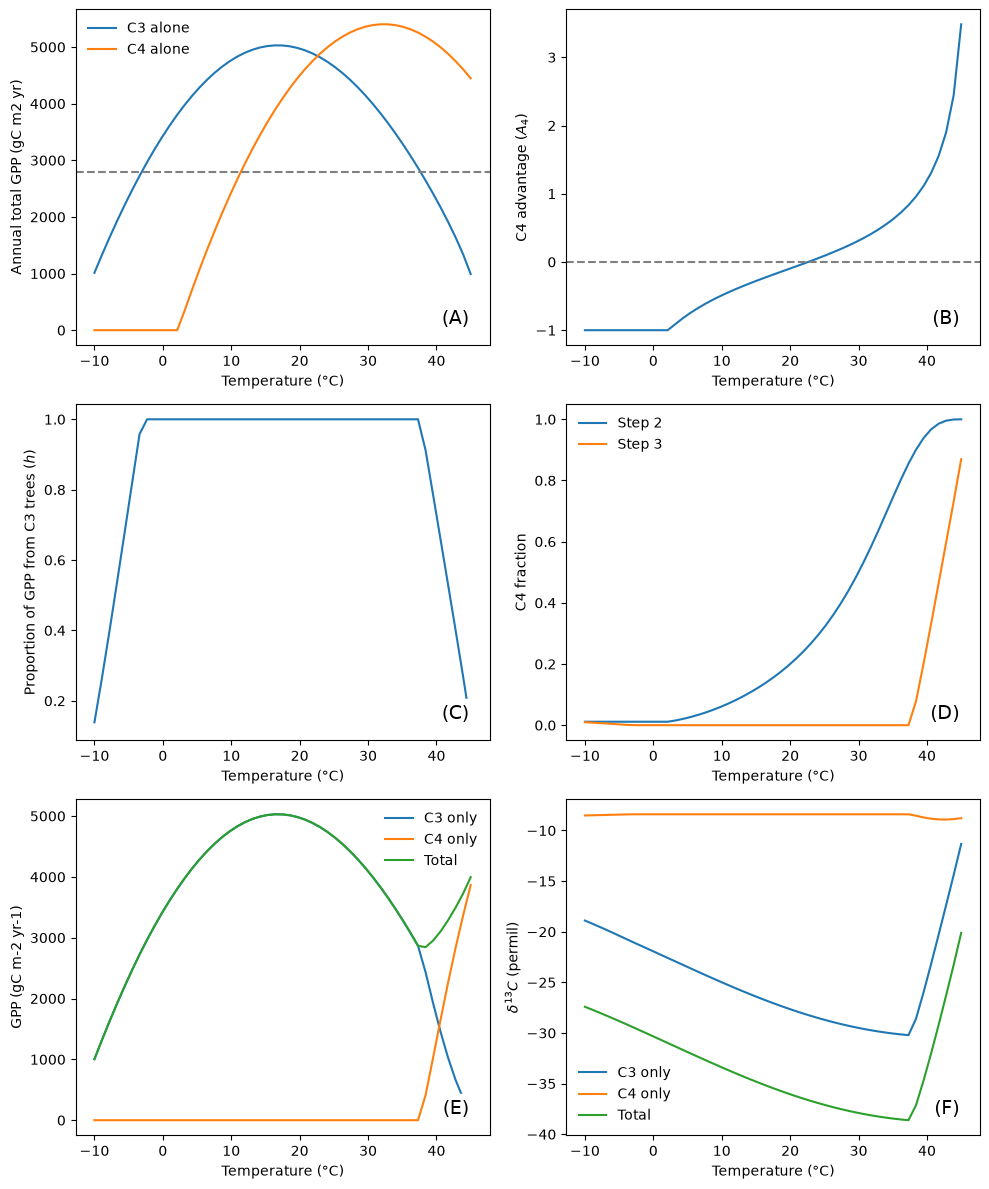
The plots below then show the various stages of the model prediction.
- Panel A
GPP predictions from the P model across a temperature gradient for C3 or C4 plants alone. The horizontal dashed line shows the canopy closure threshold for C3 plants (see Step 3).
- Panel B
The relative GPP advantage of C4 over C3 photosynthesis across the temperature gradient.
- Panel C
The proportion of GPP from C3 trees across the temperature gradient. Between roughly 5°C and 30°C, canopy closure is predicted to exclude C4 plants, even where they have a GPP advantage (Panel B, > 22°C).
- Panel D
Predicted \(F_4\) across the temperature gradient, showing the prediction purely from relative advantage and treecover (Step 2) and then accounting for the impact of C3 tree canopy closure (Step 3),
- Panel E
The predicted contributions of plants using the C3 and C4 pathways to the total expected GPP
- Panel F
The contributions of plants using the C3 and C4 pathways to predicted \(\delta\ce{^{13}C}\) .